

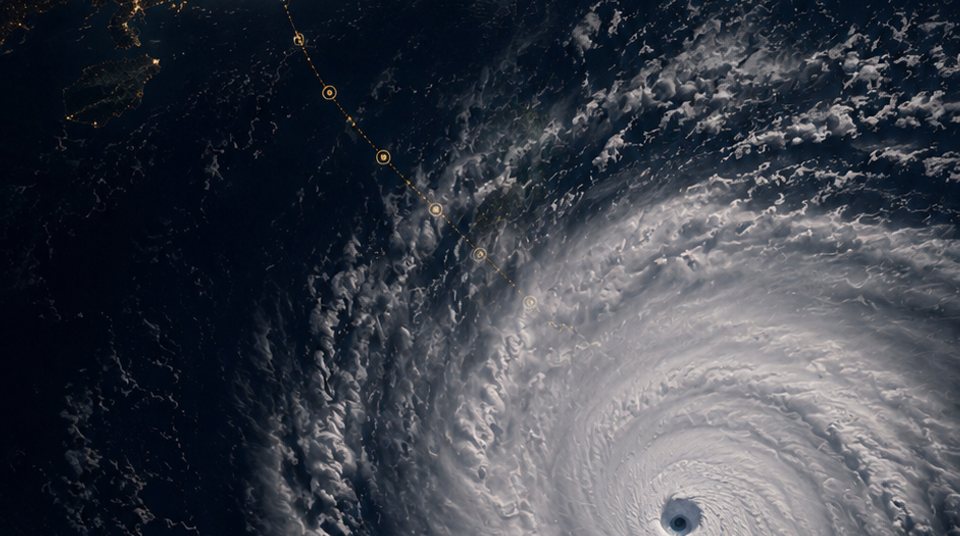
Wind radii: how big a typhoon really is
The gale radius on a storm page is the agency's figure; its threshold sits below a No. 8, and the circle is not really a circle.
A storm page shows three agency figures: distance, gale radius and speed. The gale radius is the one most often misread. Aethopia does not compute it, and it is not a No. 8 zone; it is a radius the agency reports in its analysis.
Two agencies, two sets of radii
| Agency | Ring | Threshold | Averaging | Given as |
|---|---|---|---|---|
| JMA | 30-kt area | 30 kt, about 56 km/h | Ten minutes | Two sectors, one radius each |
| JMA | 50-kt area | 50 kt, about 93 km/h | Ten minutes | Two sectors, one radius each |
| NHC | 34 / 50 / 64 kt | 63 / 93 / 119 km/h | One minute | Four quadrants each |
JMA reports each ring in two halves, for example 560 km on the east side and 330 km on the west; the NHC reports four quadrants, and in one-minute winds, which read about a tenth higher than the same wind averaged over ten minutes.
What the site draws
The gale radius on a storm page takes the larger of the two sides JMA reports and draws it as a circle. Real wind fields are lopsided: usually larger to the right of the direction of motion and smaller on the side facing land.
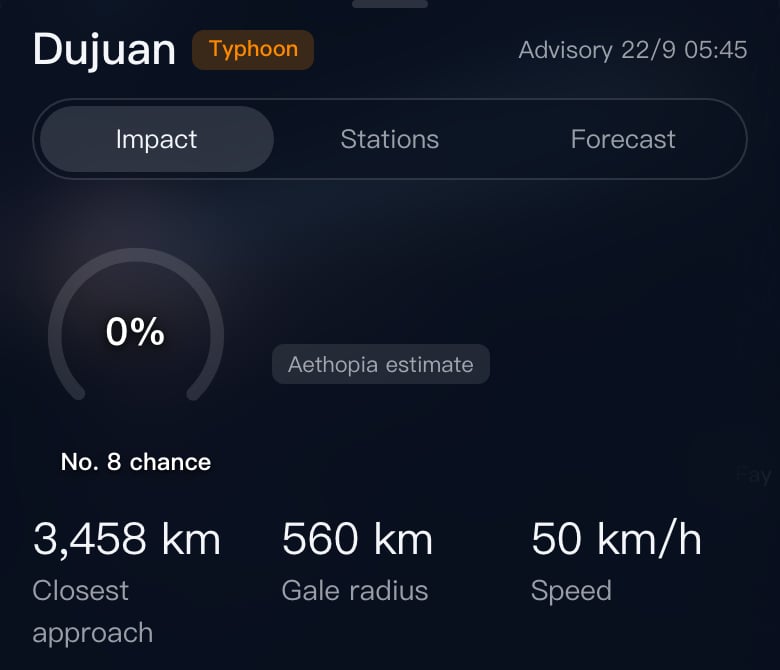
JMA reports radii only for the analysis time; forecast times carry a storm warning area that folds in position uncertainty instead. That is why the radius at closest approach often reads “not provided by the agency”. It means no figure, not no wind.
The ring and the No. 8
A No. 8 means gale or storm force wind generally near sea level in Hong Kong, 63 to 117 km/h as a ten-minute mean. JMA's 30-kt ring starts at about 56 km/h, below 63; Hong Kong inside the ring does not mean a No. 8 will be issued. The ring is also the largest side, so Hong Kong outside it does not rule one out.
The impact level on a storm page uses just two agency numbers: high when Hong Kong sits inside the gale radius at closest approach, medium within 800 km, low beyond. It is a distance judgement, not a signal forecast.
Why a radius jumps
A falling peak wind often comes with a growing ring: an eyewall replacement, a move to higher latitude or the start of weakening all spread the energy over a wider area. To judge how big a typhoon is, read the radius, not just the wind at the core.
Radii are agency analysis values, quoted as issued, never estimated or extrapolated here; the circle is a simplification. Whether a signal will be issued is a matter for the Observatory.
Further reading
- Where the rain nowcast comes from
The four half-hour cells on the Today page are the Observatory's radar-based gridded rainfall, and why there is no minute-by-minute bar.
- Eyewall replacement: why a typhoon suddenly grows
The peak wind dips a little, and the area affected gets wider.
- Hong Kong's typhoon signals, explained
What each of the five levels means in wind speed, and why the No. 8 comes in four directions.
 Where the rain nowcast comes from
 Eyewall replacement: why a typhoon suddenly grows
 Hong Kong's typhoon signals, explained