

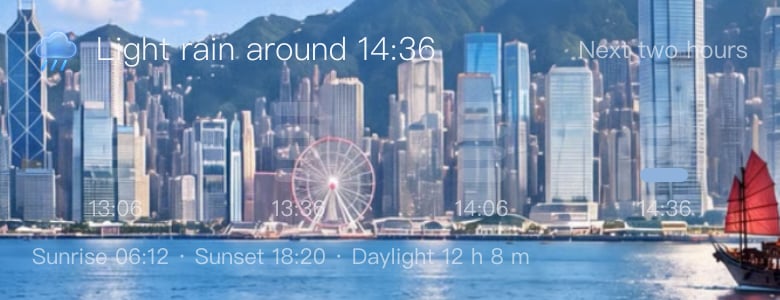
The rain strip on the Today page has four cells of half an hour each. It is not Aethopia's forecast; it is the Hong Kong Observatory's gridded rainfall nowcast, taken as published from DATA.GOV.HK. This is how it is made, how to read the four cells, and why there is no bar per minute.
How the Observatory makes it
A nowcast is radar work. The Observatory tracks how radar echoes move, extrapolates the rain areas two hours ahead and lays the result on a grid of roughly two kilometres: 121 by 121 points over the Pearl River estuary.
Each point carries four figures, the half-hour accumulated rainfall in millimetres ending 30, 60, 90 and 120 minutes ahead, and the whole set is refreshed about every twelve minutes. Aethopia archives one copy an hour and changes none of the figures.
Reading the four cells
| Half-hour rainfall | Band | Lit cells |
|---|---|---|
| under 0.5 mm | Dry | 0 |
| 0.5 to 2.5 mm | Light rain | 1 |
| 2.5 to 10 mm | Rain | 2 |
| 10 to 30 mm | Heavy rain | 3 |
| 30 mm and above | Torrential rain | 4 |
The Today page reads the cell over Central and Western. Lit cells show the band; the millimetres stay off the screen. The sentence above, such as “heavy rain from 11:30, about an hour”, is read straight from the cells, with the band word from the highest one. Below 0.5 mm in all four, the strip does not appear.
Why there is no bar per minute
The upstream figures are half-hour totals on a two-kilometre grid. A bar per minute would be interpolated between four numbers: a line that looks precise and is made up. The DATA.GOV.HK terms also permit passing the data on as published, not adapting it. So the four cells are shown as they are.
What it cannot tell you
- Rain beyond two hours. A nowcast is two hours long.
- Thunderstorms that form from nothing. Extrapolation moves existing rain; it does not create new cells.
- The exact spot under your feet. A cell is two kilometres wide; a valley and a ridge can share one.
- How old it is. Every cell carries its end time; the site archives hourly, so the first cell is sometimes already past.
Source: Hong Kong Observatory, via DATA.GOV.HK; intellectual property rests with the Government of the Hong Kong Special Administrative Region. Rainstorm and thunderstorm warnings are issued by the Observatory; the four cells are no substitute for them.
